One big improvement we could make is the harnessing of waste energy. My parents are involved in a project with the city of Burlington that is working to take the energy that is wasted at the electricity producing McNeil power plant, and use it to heat homes and businesses in the area. The plant uses sustainably, locally harvested wood to fuel its productivity, which is great, but there is also a lot of heat that doesn't get used. Currently, the heat that doesn't get used in the process of producing electricity, gets cooled with water and then released into the atmosphere. Wouldn't it be great if, instead of just increasing our carbon footprint, we actually had a use for this waste? In theory, there is enough wasted now to heat most of the buildings in the Old North End for nearly nothing (of course there is the cost of installing new pipes all throughout the ground in that section of town). This is, both socially and environmentally, the right thing to do. The number of people in the part of town (which is one of the poorest parts of Burlington), that would be affected by this would have the relief of not having a gas bill, AND we would not be burning up precious resources twice when we have the option of burning them up only once. It is a win-win, which is why I can't imagine why every power plant wasn't initially built with this idea in place, or at least why they aren't NOW incorporating it everywhere. Much of Scandinavia uses this as a resource and it is becoming more common in China as well. I think it is time for the U.S. to jump on board, it would be a very worthwhile investment.
Sunday, March 15, 2009
Harnessing Our Waste
Many conversations that I have had about current world issues lately have come back around to the idea of globalization. The system of globalization is the result of wide-spread hunger for instant gratification with disregard for possible long-term consequences. Even the way we have set up our small towns has employed the immediate gratification mentality, and now, as we are learning more about the effects we are having on the environment and seeing ways we can change, it's hard not to look back and wonder why no one put these changes into effect in the first place.

Sunday, March 8, 2009
Doing a little can go a long way
In this week's reading of the green guide it was telling us and giving all sorts of hints and ideas on how to make our ecological footprint better. The first thing of topic was talking about homes being a practical size house for our needs rather than having a giant house when there is only two people living in it, some easy tips that where given to help save us money and out environment is to shut of the lights when we leave the room, but to also change out lights to cfls or halogen lights which might cost a little more but in the long run, but last longer and use less energy which will make you money to spend a little extra money. all throughout the chapter it breaks your house down into different sections on how you insulating your house better and fixing the drafty area's in your home is'nt a hard thing to fix and will cut your fuel bill down a good chunk, or also being aware of the phantom power that your appliances even if they are shut off still draw and suck power, or when you leave your house fro work you can turn down your thermastat beacuse why does it have to stay warm when no one is there. The chapter does a great job providing you with ideas and tips how to cut costs and use less of things that in reality gives us more, it also makes you more aware on how simple practical changes do make a defference. This chapter is good at explaing different things because i think many people are nieve and dont really realize all the simple little things that you can do, does make a difference even if it is changing your lightbulb.
Monday, March 2, 2009
Sweet Pond
After our discussion of design in class today, I decided to look up eco-homes in Vermont and see what designs people had used that fit out landscape and environment. In southeastern Vermont there is a community under development called the Sweet Pond Eco-Community. This community is a group of nine eco-houses built in an apple orchard surrounding a beaver pond. Picturesque right?
The design is actually quite simple, using two simple shed form, using sheltering and the low-lying structure for passive solar.
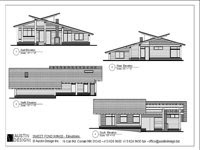
It's basically two boxes stuck together with varying roof angles. They also plan to incorporate things such as shared parking structures, shared septic, and shared water to limit land use. While these are all fine and dandy, I am still waiting for a residential home that is 100% eco-friendly, or at least above the 75% range.
Taking into account the landscape, environmental challenges, and challenges of an eco-friendly home, the conventional ideas of a house or home may not be applicable. Say you were to incorporate a living machine into your home, it would need to be a proper size to support several people and the waste that they produce, and rather than have a room dedicated to your living machine, you would need to find a way to incorporate it aesthetically into your living spaces.
I met someone the other day who had decided to build a 100% eco friendly home using a slightly altered conventional farmhouse design to blend better in the Vermont community and architectural landscape. I wonder if conventional design and aesthetics and another system that will have to be completely remade to become sustainable.
We have said in class that this is an opportunity to rebuild every system. Does that apply to cultural aesthetics too?
The design is actually quite simple, using two simple shed form, using sheltering and the low-lying structure for passive solar.

It's basically two boxes stuck together with varying roof angles. They also plan to incorporate things such as shared parking structures, shared septic, and shared water to limit land use. While these are all fine and dandy, I am still waiting for a residential home that is 100% eco-friendly, or at least above the 75% range.
Taking into account the landscape, environmental challenges, and challenges of an eco-friendly home, the conventional ideas of a house or home may not be applicable. Say you were to incorporate a living machine into your home, it would need to be a proper size to support several people and the waste that they produce, and rather than have a room dedicated to your living machine, you would need to find a way to incorporate it aesthetically into your living spaces.
I met someone the other day who had decided to build a 100% eco friendly home using a slightly altered conventional farmhouse design to blend better in the Vermont community and architectural landscape. I wonder if conventional design and aesthetics and another system that will have to be completely remade to become sustainable.
We have said in class that this is an opportunity to rebuild every system. Does that apply to cultural aesthetics too?
H2O
Through my research on Sandra Postel (my chosen subject of my in-class presentation) I have been thinking a lot about water.
What is water? Quite simply, it is the nectar of life without which all life will parish. Here in America, I don’t think that urgency of the world’s water supply is regarded as dire and important as it is. This is because we live in a place where we have access to bountiful amounts of clean, fresh water to drink, bathe, wash our cars, and water our plants and lawns. But in other corners of the world, clean fresh-water is scarce. We have all seen the commercials on TV for children.org where the advocate is holding a dirty but beautiful child, talking about how she lives in a place where she is forced to drink and bathe in dangerously contaminated water, and play in under-managed leach fields…When here in America we flush our toilets with water that is more suitable for those children to drink. My point being, we do not see on a daily basis, the urgency of the situation.
Postel’s contributions to research on water include causes such as the Global Water Policy Project: http://www.globalwaterpolicy.org/ and the Worldwatch Institute: http://www.worldwatch.org/. I encourage everyone to check out these sites!
Eventually our attention must shift to these issues, before it is too late. That day is rapidly approaching and the consequences of non-action are even more undesirable than we can imagine from our comfy lives in America where we are sheltered from the extremes of this dire situation.
growth
I believe that in order for us to start moving in the direction of sustainibility we need to define the way we grow as a civilization. instead of growing materially we need to start growing with our thoughts and experiences.Every civilization has its cap on what it can do and how it can think. If we dont think outside of the cap we have created then we cant grow as a civilization. So if our society is so bent on economic growth why cant we put the energy we expend on growing economically to growing mentally. If we all grew mentally then materialistic ideals would not be as important making it easier to give up our paridigm we have created today. Then we can grow with the grains of the earth instead of growing against them making our planet a more hospitable place to live. In washington D.C a big group of people meditated to try and reduce the crime rate by 25%. The police commissiner said it was imposible but it actually happened the crime rate was reduced by 25%.One can only imagine if everybody gave off good vibes like that there would be no crime. This is the way we need to grow with our thoughts.
Monday, February 23, 2009
The Great Soil Builders of Our Planet

I would like to direct the class focus to the magic mushroom section of Part 1 of our reading. The fungal technologies used to regenerate life in our ecosystem are outstanding. I found this to be the most interesting part of the book so far. The section I am referring to is the remediation project that used oyster mushrooms to extract the diesel fuel spill near Bellingham, Washington. What really blew my mind was that laboratory tests found virtually no toxic oil residue in either the soil or the mushrooms, the result of enzymes and acids that the fungi release that break down such molecular complexes. If this can happen over a six week time period, what other ways can we actively decontaminate our polluted earth? Can we apply spore mass to any polluted location? What is the extent of using this technology? What are some examples of contaminated locations that might be likely testing locations for fungal technologies? Land fills? Water treatment? Mountain top removal sites? Toxic waste dumps? And, are there companies that capitalize on this technology by buying cheap contaminated useless land, and covering it with oyster mushrooms. Only to then sell the land for ten time more than you originally bought it for, along with selling your mushrooms to a local food store. Weird, but possible I think................Brendan O'Connor
Sunday, February 22, 2009
Just a Thought
I just finished reading the introduction and part one of our book "Natures Operating Instructions", and it gave me something to think about for sure. The combining of the biologists and the engineers is an idea that should be looked into more and more in the future. Even now, when you look around at the machinery some engineer has designed, you can see nature in it, whether or not that is intentional is up in the air. But something as simple as a flipper you put on your foot to go diving with, I'm pretty sure no person can coin that design as theirs. It was taken from the natural design of the fin on a fish, or the foot of a water fowl. So when one looks around at nature, its necessary to think about why the processes and designs around them are there. This goes back to the Darwin theory of evolution, things evolved to adapt to their environments, or they perished. So, just as a thought, maybe we as humans could do the same thing. Learn to adapt to what we have for resources. Now, I'm not saying that we can compare ourselves to other animals in nature, because we cant, not by any stretch. But what we can do is think about where our place is in the world, what our niche is as a species, and not just as individuals. That is a very broad generalization, I know, but its an idea non the less. And maybe it will never completely come true, but goals are important for success. You shoot for one big goal by making small ones along the way, and you work with what you have, not what you wish you did. Just a thought.
Subscribe to:
Posts (Atom)